Showing posts with label whirls. Show all posts

Sunday, July 6, 2025

Everything forms in spirals.


Above: The fractal structure of the Messier-74 galaxy. In those structures energy and gravity are in an eternal race. You can also see things like holes in that gas disk, or a galactic nebula.  If there is a whirl there are four possibilities. There can form planets and the sun. But if the star that forms is too big, it blows the material disk away from its environment. And that denies the planetary system formation. Or if the disk is very massive it falls straight to a black hole. The empty places in the disk are areas where some cosmic catastrophe has blown the material away. 

Or there is a possibility that a denser spherically-shaped material cloud or nebula pulls material away from the middle of it. Or in those holes formed stars and planets or black holes pulled that gas away from those holes in the nebula. Or, maybe the extremely powerful supernovas blew cosmic gas away from that point. 

JWST found new data to explain how spiral galaxies form. There are two structures in the spiral galaxy: thin and thick. The thin disk can form earlier and then the thin structure's gravity starts to collect the thick structure around it. Those two structures move at different speeds and that causes problems with the models. 

The spiral structures that move at different speeds create the whirls that start to collect material into them. So, the star formation begins in those points. That thing explains the star, planet, and finally neutron star and black hole formation as the whirls that form around material. Or actually, all particles in the universe from the quark to the most massive objects form from whirls.


"Webb/NIRCam composite images of a quarter of the team’s sample sorted by increasing redshift. Image credit: Tsukui et al., doi: 10.1093/mnras/staf604." (SciNews, Webb Sheds New Light on Structural Evolution of Disk Galaxies)

If the whirl is large enough it can press the particle or any other object into one entirety called a singularity. The particle that spins at a very high speed binds quantum fields around itself. And how big an object can that process form? That depends on the energy level of that particle. The energy transfer into that particle continues until it can push that whirl away from it. So theoretically one single particle like a proton or electron can form a supermassive black hole. But that requires an absolutely stable environment. 

The requirement is that the particles can form such a large whirl and bind energy or quantum fields into it so fast that it cannot push that energy away. That means the particle must spin with an extremely high speed. The idea is that the black hole or any other structure in the universe creates a whirl around it. An interesting thing is that all objects from stars to planets are forming from whirl-shaped structures. The spiral galaxy is actually the supermassive black hole’s material disk. That disk keeps the supermassive black hole in its form. Without that disk, the energy that is trapped in the black hole will be released. 

The black hole’s relativistic jet tells that the gravity center is a structure that aims, or conducts energy somewhere else. Energy travels to the black hole’s spin axis and there forms the relativistic jets. The main problem is: is the source of the relativistic jet outside the event horizon or inside it? In a wormhole model, the black hole forms a gravitational tornado. The structure forms a situation where a gravitational field or quantum field forms a tornado-shaped structure. The idea of that phenomenon is that if the gravity field turns into a spiral, then that thing causes a situation where there is no gravity field in the black hole’s spin axis. Maybe that channel explains the relativistic jet. 


https://esawebb.org/wordbank/electromagnetic-spectrum/


https://www.sci.news/astronomy/webb-structural-evolution-disk-galaxies-14026.html

Sunday, September 11, 2022

Theoretical physicists introduce that black holes admit vortex structures.


That thing can be a more fundamental idea than we even can imagine. That phenomenon can make antigravitation possible. 


If black holes have vortex structures that thing is amazing. That means the black holes, or their gravitational fields act like "regular stars". But the vortexes in that star have a different scale. And their energy level is different. 

In a normal star like the Sun, the electromagnetic fields make many things, like flares and protuberances. In and near black holes the gravitation makes similar structures. The thing is that somewhere near the event horizon. 

Also, gravitational waves are orbiting black holes. So that means there is one thing that can control gravitation and that thing is another gravitational field. Today we know that gravitation is radiation or wave motion. And we know that gravitational waves are like light. The speed of gravitational waves is the speed of light.

And that means the gravitational waves can also orbit the black holes. Or they should do that thing. There are also whirls in the gravitational field, Like in all other power fields. But the thing that there is suspected of being vortexes or whirls in the structure of Black Holes is fantastic. 

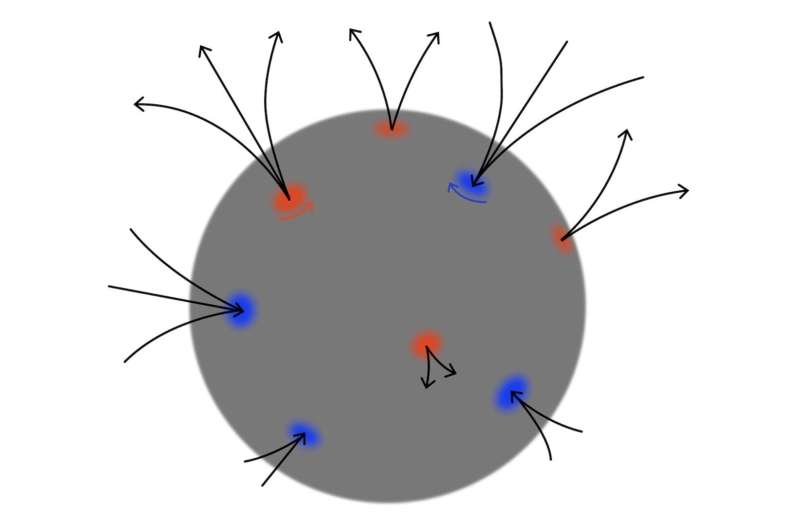
The image above portrays the black hole. Which has vortexes of whirls in its gravitational field. Those vortexes are like sunspots and the black hole sends the gravitational radiation or gravitational flares and protuberances through space. In that vision, the black hole is like a normal star that sends gravitational versions of the solar phenomena. The thing is that the arrows portray an energy flow in and out from the black hole. 


Gravitation is wave motion. And that means gravitation can be neutralized by using gravitational waves that impact each other. If those impacting gravitational waves have the same energy level. They neutralize each other. 


When energy or wave motion impacts with other energy or wave motion that travels in opposite direction their energy level rises. That requires that those wave motions have the same frequency. The wave motion with the higher energy level continues its journey in its direction. But turning that wave motion requires energy. And if the energy level of those impacting wave motions is the same. That means those impacting wave and counterwave motions stop. 

Their energy level is rising. But they cannot go through each other. That means there is the possibility that some black holes have a hollow singularity. At that point, the gravitational waves are forming the wall where the gravitational field's power is extremely high. In that case, the black hole has two event horizons. 


Gravitational vortexes and antigravitation. 


Gravitation is wave motion like all other wave motions. There is a possibility to create a gravitational tornado that can make antigravitation possible. That gravitational tornado can pull gravitational waves away from their direction. 

In some cases, the idea of antigravitation basing on the idea of impacting gravitational waves. The idea is that when an object sends the gravitational waves to the gravitational center with the same energy level. That thing denies that those gravitational waves cannot that are coming from the gravitational center cannot reach the object. 

Gravitation is wave motion. And in some other models, the system just curves gravitational waves away from the object. That thing can happen by creating gravitational tornadoes around the object. And those gravitational whirls are pulling gravitational waves away from the craft or some other objects. 


Sources and images:

https://phys.org/news/2022-09-theoretical-physicists-black-holes-vortex.html


https://miraclesofthequantumworld.blogspot.com/

Quantum systems require a new way to think about math.

"IISc physicists discovered that Ramanujan’s classic π-formulas arise naturally in modern theories describing critical phenomena and bl...